When Everything Becomes Easy, Raise the Difficulty

AI is commoditizing programming. It is tearing down many of the technical barriers that once kept people out of entire industries and fields. The same thing is beginning to happen in art: skills that used to require years of practice can now be approximated in a few seconds.
Lowering those barriers is not necessarily bad. More people can create, experiment, and turn an idea into something real. But if the cost of producing something keeps falling, then we also have to change what we choose to produce and consume.
When a tool makes the process easier, our ambitions should become harder.
This matters to me because everything around us is beginning to feel easy. We ask a question and receive an answer before we have had time to sit with the problem. We are getting used to skipping the uncomfortable part where we are confused, try something, fail, and slowly begin to understand.
I am not against using AI. I use it, and refusing it completely would miss what makes these tools valuable. But if we are going to use it, we need to raise the difficulty of our challenges until they still demand something from us. The goal is not to invent tasks AI cannot touch. It is to build tasks that still make us think while we use it.
What The Measurements Show
That used to be an intuition. It is starting to be a measurement.
The most direct evidence is an EEG study from the MIT Media Lab. Nataliya Kosmyna and colleagues had 54 participants write essays with an LLM, with a search engine, or with nothing at all. Brain connectivity scaled down with the amount of help: the unaided group strongest, search engine users in the middle, LLM users weakest. When the conditions were swapped in a fourth session, the people who had spent months writing with an LLM stayed under-engaged writing alone. They also reported the lowest sense of ownership over their essays, and struggled to quote work they had written themselves.
That last detail is the one I keep returning to. The cost was not only measured in performance. It was measured in whether the work still felt like theirs.
Programming looks similar. Judy Hanwen Shen and Alex Tamkin ran randomized experiments on developers learning an unfamiliar library, and found that AI assistance impaired conceptual understanding, code reading, and debugging while delivering no significant efficiency gain on average. A meta-analysis of 23 studies puts it plainly: coding assistants show a moderate positive effect on productivity and no significant effect on learning. We are buying output. We are not buying understanding.
But We Survived The Calculator
The obvious objection is that this has all happened before. Calculators atrophied mental arithmetic, nobody misses long division, and the world is fine. Some skills should be delegated and forgotten.
I think that is true, and it is why I am not arguing for refusal. But a calculator delegates a procedure. It runs the same algorithm every time, and you can sanity check its answer against a rough estimate you made yourself. It never told you which equation to write.
What AI delegates is judgment: framing the problem, deciding whether an answer is any good, knowing what to do when it is not. That is the part you cannot supervise without having built it first. Shen and Tamkin frame their entire study around that gap, because we still do not know how AI assistance affects the skills needed to supervise AI. Nobody ever had to supervise the calculator.
Difficulty Is A Design Problem
The encouraging part is that none of this is a property of the tools.
Robert and Elizabeth Bjork spent decades on a distinction that sounds pedantic and is not. Performance is what you can do during practice. Learning is the change that lets you do it later, somewhere else, under conditions you did not rehearse. The two routinely come apart: conditions that make practice feel smooth produce fast performance and poor retention, while conditions that slow you down feel worse and teach more. They call these desirable difficulties, and they are blunt about why the problem persists. Learners reliably prefer the conditions that teach them least, because fluency feels like competence. It is the same illusion that shows up in front of AI-generated code, arriving from a different literature decades earlier.
Majeed Kazemitabaar and colleagues tested the remedy directly. They built seven techniques for forcing deeper engagement with generated code, and the most effective was also the most demanding: instead of showing the solution, the system walks you through the problem and makes you state what needs to happen at each step before the code appears. The friction is the feature. Shen and Tamkin reached the same place from the other end. Of the six interaction patterns they observed, the three involving real cognitive engagement preserved learning even with AI help. What mattered was not whether AI was present, but whether the person was still doing something hard while it was.
It may also compound over a lifetime. Among 7,003 Norwegians tracked from 30 to 65, those on the most routine career trajectories carried a substantially higher risk of cognitive impairment and dementia after 70. The study is observational and some of the effect plausibly runs the other way, but the direction holds across cohorts. How much thinking we hand over may not only be a question about this quarter.
What I Am Building
Malla: Before the Silence is a small attempt to test all of this.
It is a browser game played through the field terminal of Ellie, a maintenance engineer, on the night a military and corporate alliance seizes the city’s infrastructure. She has one objective: reach Tom, her partner, at an old analog repeater before communications disappear. There is no combat and no omnipotent hacking. The tension comes from ordinary systems — transport, radio, identity, logistics — being turned into instruments of control.
Five acts, four real problems:
Every algorithm changes Ellie’s physical situation. That is the whole design constraint.
The last row is the one I care about most. When the story no longer needs a technical layer, it goes. Difficulty is there to serve something, and the moment it stops serving it, it is just homework.
The game also ships no calculator, no editor, and no interpreter. You copy the evidence out and solve it with whatever you want, and that includes AI. What protects the difficulty is that instances are generated from a deterministic seed, so there is no answer to look up and nothing to recognize, only the problem in front of you.
Which sounds like a contradiction. I have spent this whole piece arguing that AI erodes judgment, and then I built something that hands you the AI on the first screen.
It is not a contradiction, because what the model is good at is not what the game is testing. Nothing in the evidence tells you that Act I is an erasure problem. You get four sources — a capture, a protocol, a diagnostic, an integrity record — that describe the incident from different angles and deliberately name neither the method nor the tool. Working out that two slots are missing, and that P and Q are enough to recover them, is the challenge. After that, doing the GF(2⁸) arithmetic yourself or asking a model to do it is a difference of tedium, not of understanding.
The cost structure holds that line. A malformed command costs nothing, so the interface is free to learn. A well-formed answer that is wrong costs time and raises your exposure. That is exactly the shape of a language model’s mistake — fluent, plausible, confidently wrong — and it is the only error the game charges for. Delegate the arithmetic and nothing happens. Delegate the judgment and the node notices before you do.
Which is Shen and Tamkin’s result restated as a design rule. The question was never how to keep AI out. It is where to put the part that cannot be delegated, and how to make delegating it expensive.
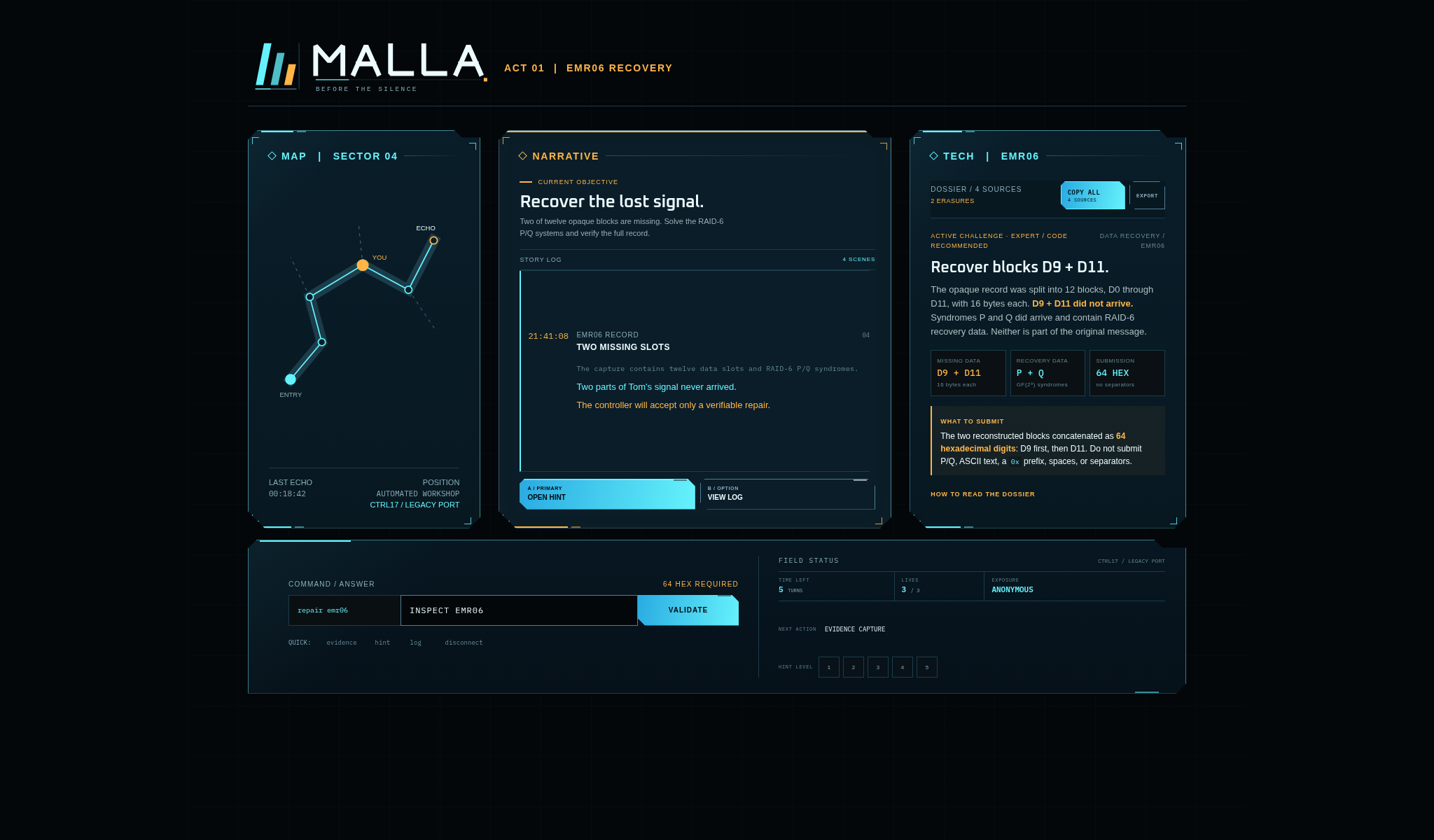
The current prototype combines the story, world map, and technical challenge in a single interface.
This is what I think Hack The Box is still missing. Its challenges can be excellent, but the experience around them is a container for exercises rather than a world you want to keep exploring. Malla is still a very basic MVP. You can play the prototype or read the source on GitHub.
I was making this argument with a game before I knew anyone had measured it. A challenge that survives contact with AI is one where the answer is not the product. The understanding is.
That principle extends past programming. As creation gets cheaper and answers get immediate, what we consume should ask more of us, not less. Games should trust us with difficult systems. Stories should leave room for interpretation. Learning should include problems that cannot be finished by copying the first plausible response.
None of this is stable, and I would rather say so than pretend otherwise. Today that inference is the hard part. At some point a model will read those four sources and make it too, and the problem I built will stop being a problem. That is not a hole in the argument. It is the argument. Every time the tool improves, the floor rises, and the only response that preserves anything is to raise the ceiling with it.
We made everything easier. Now we have to start making difficult things again.
Sources
- Nataliya Kosmyna, Eugene Hauptmann, Ye Tong Yuan, Jessica Situ, Xian-Hao Liao, Ashly Vivian Beresnitzky, Iris Braunstein, and Pattie Maes, “Your Brain on ChatGPT: Accumulation of Cognitive Debt when Using an AI Assistant for Essay Writing Task”, 2025.
- Judy Hanwen Shen and Alex Tamkin, “How AI Impacts Skill Formation”, 2026.
- Sebastian Maier, Moritz Gunzenhäuser, Jonas Schweisthal, Manuel Schneider, and Stefan Feuerriegel, “A meta-analysis of the effect of generative AI on productivity and learning in programming”, 2026.
- Nicholas C. Soderstrom and Robert A. Bjork, “Learning Versus Performance: An Integrative Review”, Perspectives on Psychological Science, 2015.
- Robert A. Bjork and Elizabeth L. Bjork, “Desirable Difficulties in Theory and Practice”, Journal of Applied Research in Memory and Cognition, 2020.
- Majeed Kazemitabaar, Oliver Huang, Sangho Suh, Austin Z. Henley, and Tovi Grossman, “Exploring the Design Space of Cognitive Engagement Techniques with AI-Generated Code for Enhanced Learning”, 2024.
- Trine Holt Edwin, Asta Håberg, Ekaterina Zotcheva, Bernt Bratsberg, Teferi Mekonnen, Yaakov Stern, Vegard Skirbekk, and Bjørn Heine Strand, “Trajectories of Occupational Cognitive Demands and Risk of Mild Cognitive Impairment and Dementia in Later Life: The HUNT4 70+ Study”, Neurology, 2024.