The Last Machine We Need to Build
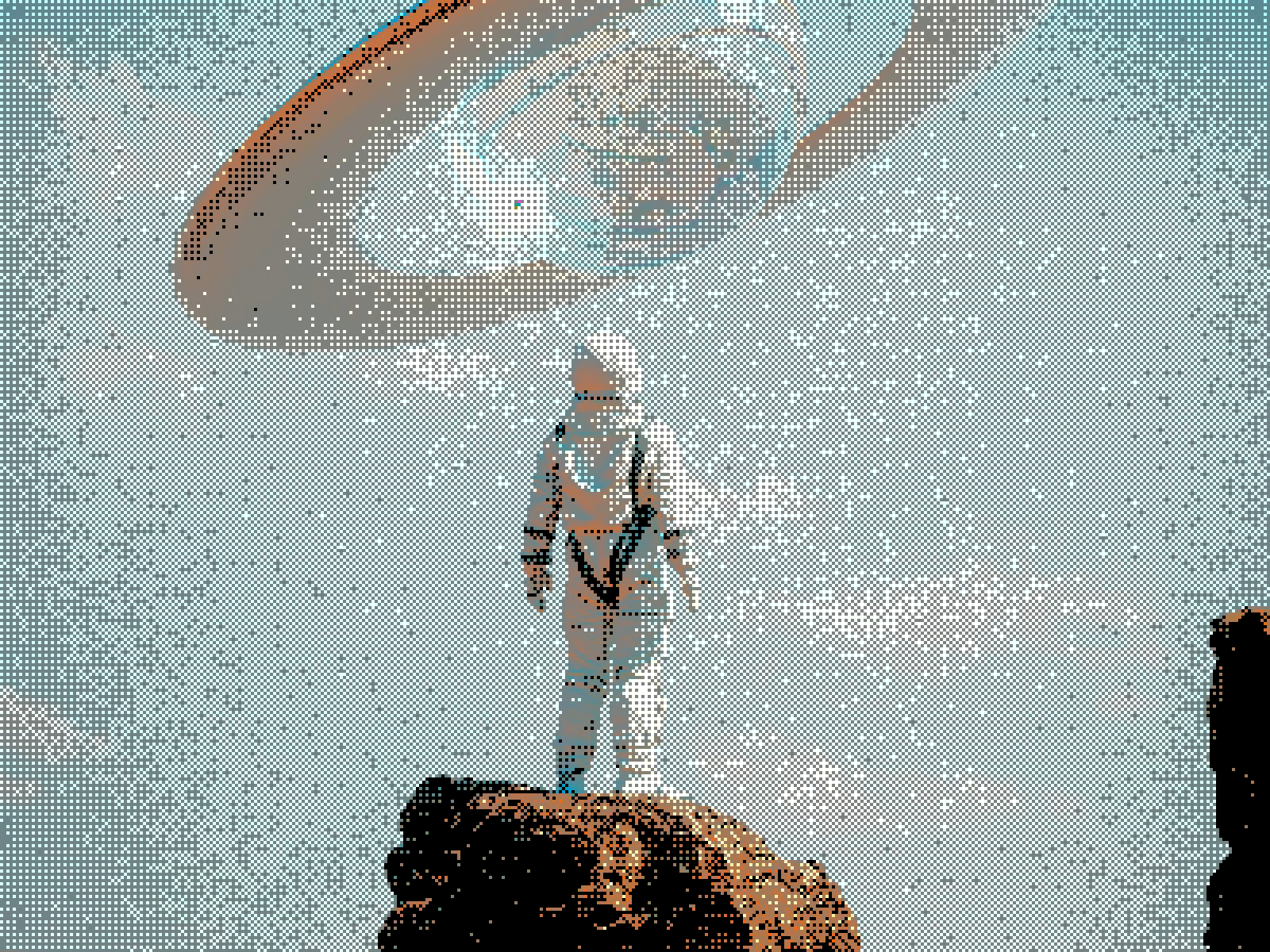
Most machines transform something and eventually become part of what must be maintained. A lathe shapes metal, but it does not build lathes. A computer transforms symbols, but it cannot fabricate the processor on which those symbols are transformed. A factory produces objects, but depends on another industrial system for its tools, energy, replacement parts, and control.
A universal constructor would belong to a different category. Given an adequate description and generic resources, it would be able to construct any machine permitted by its physical substrate. If its repertoire included itself, the boundary between product and productive system would close: the machine could build the machinery required to build again.
The question is:
What would it mean for humanity to create a physical system capable of constructing machines including another instance of itself?
1. The logical closure of construction
Von Neumann’s central insight was not that a machine could somehow inspect every atom of its body and duplicate it. It was that self reproduction could be decomposed into operations with different relationships to information.
Let be a finite description of a machine . In a simplified decomposition, contains:
- a builder , which interprets descriptions and constructs what they specify;
- a copier , which duplicates descriptions without interpreting their meaning;
- a controller that orders these operations;
- and the description itself.
The builder uses as a program and constructs a new body . The copier treats the same as passive data and produces . The controller then joins the new body and copied description. Schematically,
where represents the required raw resources.
The two appearances of the description solve the apparent regress. The description does not need to contain another description of the physical process that copies the description, followed by a description of that description, forever. It is interpreted once and copied once. The copying operation belongs to the machinery, not to an infinitely nested blueprint.
This architecture is often summarized as replicator plus vehicle. The replicator stores information that can be copied; the vehicle contains the copier and the programmable constructor that executes it. Marletto, Deutsch, and Vedral argue that this separation is not merely sufficient for accurate biological reproduction under “no design laws.” A high fidelity replicator is necessary if a complex object is to reproduce accurately without its detailed design already being hidden in the laws of physics.
That claim is stronger than the familiar analogy with DNA. It says that modular, copiable instructions may be a general physical requirement for cumulative, high fidelity construction. The semantic complexity of the instructions does not have to be understood by the copying process. A genome can be copied because of the distinguishable physical states in which its symbols are embodied; a separate mechanism can later interpret those symbols.
This is the first requirement of the last machine: it must keep knowledge of construction separate from the machinery that enacts and transmits that knowledge.
2. Computation is not construction
It is tempting to believe that a universal computer can do anything describable by an algorithm. That statement quietly changes the meaning of “do.” A computer can simulate a hurricane without producing wind, evaluate a molecular design without synthesizing it, and print the description of a machine without producing the physical machine.
The difference becomes exact in the work of Jordan Cotler, Clément Hongler, and Barbora Hudcová. They distinguish two notions of computational universality for cellular automata:
- Local universality: a cellular automaton can host a localized universal Turing machine, using encoders and decoders whose computational complexity is appropriately bounded.
- Global universality: it can simulate any cellular automaton of the same or lower dimension while preserving spatial locality through local, translation invariant encodings.
They then define universal self replication as an intermediate dynamical capability and prove the strict hierarchy
The direction of these inclusions matters. Global universality is the strongest property: a globally universal cellular automaton can reproduce the spatial dynamics of a cellular automaton containing a universal self replicator. Local Turing universality is weaker. It can implement arbitrary symbolic computation inside a bounded, growing region, but this does not guarantee that its physical dynamics can create additional instances of the computing mechanism.
Cotler and his coauthors demonstrate the separation with a one dimensional “non talking heads” cellular automaton. Its isolated heads can perform universal computation, but communication between heads is deliberately blocked. Each head marks exclusive territory, and heads halt when they encounter one another’s regions. The system can manipulate and transcribe information, yet it cannot coordinate the physical production of more heads. It is Turing universal but fails even the authors’ minimal local condition for non trivial self replication.
This also explains why a quine is not a self reproducing machine. A quine prints its own source code. It reproduces the description of a copier, not the physical copier that performs the printing. After the quine runs, the number of computers has not increased.
The result does not say that computation is irrelevant. In Cotler, Hongler, and Hudcová’s framework, local universality is necessary for a universal self replicator. It is simply not sufficient. Their paper also constructs a universal self replicator in one dimension, showing that two dimensional geometry is not a fundamental requirement, and leaves the self replicating status of Rule 110 as a conjecture rather than a consequence of its known Turing universality.
For humanity, the implication is immediate: an AI that can generate every required blueprint is still only one layer of the system. Intelligence can select and revise descriptions. It does not remove the need for energy capture, material transformation, assembly, error correction, and reproduction of the machinery that performs those operations.
3. A substrate must permit replication
Even the correct logical architecture does not imply that arbitrary physical rules will support it. A description, builder, and copier must inhabit dynamics in which localized structure can persist, interact, and proliferate without dissolving into inactivity or chaos.
Don Yin’s self replication phase diagram asks where these conditions appear in a restricted but exhaustively searchable universe: all binary, outer totalistic cellular automata with a Moore neighborhood. Each rule is located using two main parameters:
- , the fraction of entries in the rule table that produce a non quiescent state;
- , a weighted measure characterizing how the rule disrupts a quiescent background.
The study reports that rules, or , pass its first and most permissive test: bounded patterns appear in a strictly increasing number of copies over the screening period. But this number must not be quoted as if of all rules contain organisms. Yin uses three detection tiers:
- Pattern proliferation: copy counts increase repeatedly.
- Extended confirmation: proliferation persists under a longer simulation.
- Causal perturbation: an isolated seed replicates, and deleting individual cells usually prevents replication, showing that the pattern’s organization is causally important.
Of a sample of first tier positives, survived extended confirmation. Of the confirmed rules, passed the specified causal fragility threshold. Multiplying the tier rates gives an estimated causal self replication rate across the complete Life like rule space. Other confirmed patterns were robust to single cell deletion, depended on distributed multi pattern dynamics, or could not be extracted, so even the strongest number depends on an operational definition rather than marking an uncontested boundary between life and non life.
The location of the successful rules is more informative than the count. Replication concentrates at low rule density, approximately –, and in a weakly supercritical regime. Using the Derrida coefficient to measure the growth of small perturbations, Yin reports a mean for first tier positive rules and for negative rules. Both are above the critical value , but replicators do not peak in the deepest chaos.
The strongest statistical discriminator is approximate mass conservation. Replication positive rules have a mean mass balance score of , compared with for negative rules, with lower values indicating smaller changes in live cell count. In a multivariate predictor combining , , mass balance, spatial entropy, and higher order information measures, mass balance carries the largest standardized coefficient.
The technical lesson is not that all real self reproducers must conserve a literal number of active cells. It is that productive dynamics require a narrow compromise:
Too little activity and nothing propagates. Too much and structure is erased. Too little conservation and the substrate cannot preserve organized matter long enough to make another organized system.
This is the second requirement of the last machine: its environment cannot be treated as an unlimited blank canvas. The machine and its substrate must jointly preserve resources, boundaries, and causal structure throughout construction.
4. Replication is not reproduction
An exact copy gives us multiplication. It does not yet give us evolution.
Hiroki Sayama and Chrystopher L. Nehaniv make a useful terminological distinction:
- Self replication produces effectively identical copies.
- Self reproduction permits variation that can be inherited by descendants.
They reconstruct von Neumann’s original problem in two parts. The first asks how a mechanistic system can produce something as complex as itself. The constructor description copier architecture answers that. The second asks how complexity can increase across generations. Answering it requires heritable variation and selection, not faithful copying alone.
The review describes two mechanisms von Neumann considered. One is reproduction by self examination, a system progressively inspects its own structure and constructs another without storing a separate complete genome. The other is reproduction from an explicit description that is both executed and copied. Biology primarily exemplifies the second, but the logical possibility of the first warns us not to equate all reproduction with DNA like tapes.
Sayama and Nehaniv use a demanding criterion for non trivial self reproduction: the system must be capable of inheritable mutation in addition to copying itself. Their evoloops illustrate why this matters. Evoloops are self reproducing loops in a deterministic cellular automaton whose collisions generate variations, whose altered structures can remain viable, and whose reproductive performance produces selection without an externally assigned fitness function. The rules do not contain an explicit command to “select” an individual. Selection emerges because some inherited configurations persist and reproduce better in finite space.
This changes the object humanity would be creating. A self replicating constructor is a machine population. A self reproducing constructor with heritable variation can become a technological lineage.
That does not guarantee open ended evolution. The review emphasizes that artificial evolutionary systems often converge toward one or a few dominant forms. Robust self maintenance, repair, individuality, and autopoiesis remain open problems. In particular, integrating construction with a boundary and a network of processes that continually regenerate one another has not been achieved by the universal self reproducers surveyed there.
This distinction is essential for both ambition and safety. Perfect copying preserves a design and its defects. Variation can repair limitations and adapt to new environments, but it also means that control must persist through inheritance rather than through one initial specification.
5. From a cellular automaton to physics
A cellular automaton proves that a logical organization is possible under a chosen set of rules. It does not prove that a corresponding machine can be constructed from atoms under the laws of our universe.
Constructor theory attempts to move the question from a particular automaton to fundamental physics. In the formulation reviewed by Marletto, Deutsch, and Vedral, a task is a specification of allowed input to output transformations,
A constructor for performs the transformation while retaining the ability to perform it again. The ideal constructor is not assumed to exist as a perfect finite object. A task is called possible when the laws of physics impose no upper bound, short of perfection, on the accuracy and reliability with which increasingly capable approximate constructors could perform it.
This changes the meaning of universality. A universal computer performs every computable transformation of symbols. A universal constructor, if the laws of physics permit one, would perform every physically possible task for which it receives the required knowledge. Its repertoire would therefore be limited not by imagination but by the division between possible and impossible physical transformations.
The qualification “if” is important. Constructor theory is a proposed framework composed of conjectured physical principles. The 2026 review discusses experiments and experimental proposals involving information, thermodynamics, hybrid quantum systems, and witnesses of non classicality. It does not report the construction of a universal constructor.
The paper nevertheless specifies what such a device would demand. It would necessarily be macroscopic and open. Supplying only a program means it must secure raw materials and power, perform its own maintenance, and manage the side effects of construction. Those functions cannot be removed by treating them as external services, because the supposedly universal system would then be only a component of a larger constructor.
This exposes the real engineering target:
Every term hides its own constructors. Energy converters require replacement parts. Material processors require sensors and control. Error correction requires a stable distinction between valid and invalid states. The description is not enough; the entire causal loop must remain available.
6. Why a constructor must operate in time
Constructor theory describes laws as timeless statements about which tasks are possible and impossible. This creates an apparent problem: construction is a process, and a constructor must finish one cycle before it can perform another.
David Deutsch and Chiara Marletto’s constructor theory of time addresses this by deriving duration relative to physical timers rather than assuming time as an external parameter in the fundamental laws. A constructor must produce not only an output but also a physically distinguishable indication that its task has completed. Otherwise a device that alternated forever between “yes” and “no” could falsely count as deciding an undecidable problem.
Their minimal timer has distinguishable starting, running, and completed attributes. Timers with the same duration form an equivalence class because, when isolated and started together, they complete together. Ordinary dynamics can then be recovered by expressing the changing attributes of one isolated substrate relative to the attributes of these timers.
For our machine, this is more than a philosophical detail. Self reproduction is not the existence of two similar configurations at different locations. It is an organized causal sequence with completion conditions:
Accuracy without repeatability is manufacturing, not construction in the constructor theoretic sense. Repeatability without a completion signal cannot coordinate descendants. The last machine therefore needs not only a blueprint and a body, but a reliable internal account of when a task has ended and another may begin.
7. Where the complexity goes
The physical size of a constructor is not the same as the complexity of the system that makes construction possible.
Andrew Bayly’s self published Zero Cell/Zero Residue Universal Constructor is a useful, if not peer reviewed, demonstration of this tradeoff. Bayly describes a 15 state Moore neighborhood cellular automaton with no permanent constructor body cells. In its minimal self replication configuration, the genetic tape occupies 12 cells and the reported replication period is 27 ticks. Temporary construction and transmission structures annihilate themselves, leaving no residue.
The design obtains this compression through four main choices: it uses the same representation for tape and action signals, grows the new tape through a propagating “wake,” reuses construction paths for transmission, and embeds Wireworld as a separate Turing complete payload substrate. The last choice lets the constructor deposit arbitrary Wireworld configurations instead of implementing general computation inside its construction mechanism.
Calling the body “zero cell” does not make the total system simple. The tape still exists, the cellular space supplies synchronous updates and a Moore neighborhood, and the rule table contains the specialized construction behavior. Bayly explicitly reports a much higher ruleset complexity score than earlier, physically larger constructors. The design has compressed the visible body partly by moving complexity into the substrate’s laws.
This is a general warning for every proposed universal constructor. Complexity can move among at least four places:
A tiny replicator operating in an environment engineered to perform most of the work is not an autonomous universal constructor. When evaluating the last machine, we must measure the full closed system, not only the object we choose to draw a boundary around.
8. What its existence would mean for humanity?
The existence of such a machine would not end invention. It would change what an invention is.
Today, a design becomes physical only through a distributed industrial body. Even a simple computer depends on mines, refineries, chemical plants, precision tools, energy networks, logistics, software, and human knowledge. The product does not contain the productive system that makes it possible.
A universal constructor would make descriptions operationally deeper. Knowledge would no longer specify only what existing factories should do. Within the machine’s repertoire, knowledge could reconstruct the capacity to manufacture. A sufficiently closed constructor could turn generic resources into tools, use those tools to produce more specialized tools, repair the chain, and finally reproduce the system that keeps the chain available.
Four consequences follow.
First, productive capacity would become transmissible as information plus a seed system. The important artifact would no longer be a finished object but a description that a sufficiently capable constructor can instantiate. This would not abolish scarcity, possible tasks still require matter, free energy, time, and error tolerance. It would change which parts of production must be transported as finished structure and which can be regenerated from knowledge.
Second, technology could acquire heredity. Once the constructor reproduces its description and vehicle, improvements can propagate through descendants. If variation is permitted and selection acts on performance, technology ceases to be only a succession of models designed independently by humans. It becomes a population with lineages. Human engineering would shift from specifying every artifact to specifying architectures of inheritance, variation, repair, and admissible change.
Third, control becomes a problem of dynamical invariants. A conventional machine can be stopped, repaired, or replaced as a single object. A reproducing population persists through copies. Safety properties must therefore survive copying errors, environmental interactions, competition, and possibly evolution. The relevant question is not only “Does the parent obey?” but “What properties remain true for every reachable descendant?”
Fourth, productive capacity could become ecological infrastructure. A bounded constructor deployed near a damaged ecosystem could use renewable energy and carefully selected nonliving materials to manufacture and maintain sensor networks, water purification systems, soil remediation modules, native plant nurseries, nesting structures, wildlife corridors, or reef scaffolds. Because it could reproduce its tools instead of depending on a distant industrial chain, a small seed system could support restoration for decades: monitoring threatened populations, replacing failed equipment, removing pollutants, and rebuilding the physical conditions in which species can reproduce themselves.
The environmental value would come from constrained replication, not maximum replication. A machine that treats biomass as generic feedstock or competes with organisms for energy and matter would become another invasive pressure. Ecological constructors would therefore need explicit material budgets, bounded construction zones, authenticated descriptions, limits on copy number and lifetime, and reliable recovery or decomposition pathways. None of the papers cited here demonstrates these applications; they make the underlying inference possible: once construction, maintenance, and reproduction form a closed technological loop, that loop could be directed toward repairing parts of the biosphere that human industry has damaged.
None of the six works that we have cited establishes that a physical universal constructor is achievable. They establish something more focus:
- the logical architecture of reproduction can be stated mechanically
- computational universality alone cannot provide it
- only restricted regions of dynamical rule space sustain even operational forms of replication
- replication must be separated from heritable reproduction and evolution
- a physical constructor must include accuracy, repeatability, resources, and maintenance
- and reductions in visible machinery can conceal complexity in descriptions, environments, or laws.
Nor would the existence of a self replicating constructor automatically make it alive. The works surveyed here leave individuality, self maintenance, autopoiesis, adaptation, and open ended evolution as distinct requirements. But the machine would cross a boundary no previous human technology has crossed: it would make the means of production one of its own possible products.
That is why it could be the last machine we need to build not because it would be the final machine, but because every machine after it could be a descendant.
Sources
- Jordan Cotler, Clément Hongler, and Barbora Hudcová, “Self replication and Computational Universality”, 2025.
- Chiara Marletto, David Deutsch, and Vlatko Vedral, “Tests of Constructor Theory”, 2026.
- David Deutsch and Chiara Marletto, “Constructor Theory of Time”, submitted 2025, revised 2026.
- Don Yin, “The Self Replication Phase Diagram: Mapping Where Life Becomes Possible in Cellular Automata Rule Space”, 2026.
- Hiroki Sayama and Chrystopher L. Nehaniv, “Self Reproduction and Evolution in Cellular Automata: 25 Years After Evoloops”, Artificial Life 31(1), 2025.
- Andrew Bayly, “Zero Cell/Zero Residue: A Principle for Minimalist Universal Construction”, 2025.